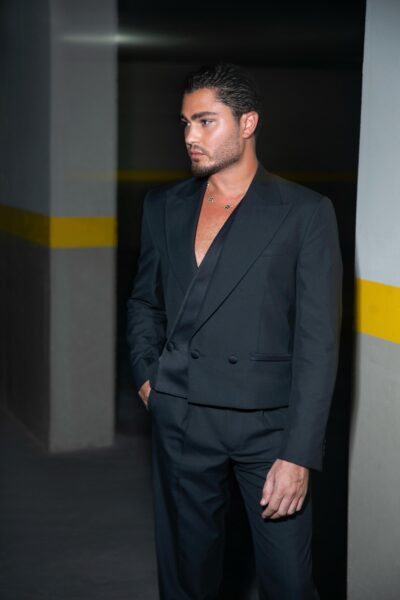
Jean-Charles Zakaria is a distinguished fashion designer renowned for his early passion for fabrics, patterns, and textures, which sparked his journey into fashion. Launching his first haute couture collection, “Re-belle,” at the age of 18, Zakaria quickly gained acclaim as one of the Arab world’s most talented young designers. His brand, rooted in authentic self-expression and refined craftsmanship, has grown internationally with ateliers in Beirut, Riyadh, and Dubai. Recognized for empowering individuality and timeless style, Zakaria’s work blends cultural influences and personal stories, earning him accolades such as the number one designer in the Middle East and debuting at Paris Fashion Week.
What sparked your interest in fashion at such a young age, and how did your childhood experiences influence your style?
Since I was a child, I’ve always been drawn to the small details in clothing, the cuts, the fabrics, and even the stitching. I used to watch how people dressed and try to understand why certain pieces stood out to me. That curiosity is what led me to start experimenting, modifying, and designing at a young age. My childhood played a significant role in shaping my style, as it was filled with emotions and experiences that later became sources of inspiration. For me, every piece I design carries a feeling or a story, often influenced by a real moment I’ve lived or an emotion I’ve felt.
You were crowned the smallest fashion designer in the Arab world in 2013. How did this recognition impact your career trajectory?
Being recognized as the smallest fashion designer in the Arab world in 2013 was a turning point for me. At such a young age, it gave me a sense of validation that what I was doing truly mattered, not just to me, but to others as well. It opened many doors and gave me opportunities to connect with people in the industry whom I had only looked up to before. But more importantly, it pushed me to take my passion more seriously. It made me realize that age doesn’t define capability, and that message still drives me today.
Your first haute couture collection, “Re-belle,” was launched at the age of 18. What inspired this collection, and what were some of the challenges you faced?
“Re-belle” was a very personal collection for me. It was inspired by the idea of rebellion, but not in the loud, aggressive sense. It was more about inner rebellion: breaking free from limitations, from expectations, and even from my own fears. At 18, I was going through a lot emotionally and creatively, and this collection became my way of expressing that transformation.
One of the biggest challenges was the pressure I put on myself. I wanted every piece to say something, to carry emotion, and to reflect a certain level of craftsmanship that’s expected in haute couture. I was also still learning the business side of fashion, so managing everything from design to execution at that age was intense. But in the end, it taught me so much and confirmed that this is what I was born to do.
You pursued an internship at the London Fashion School. How did this experience shape your understanding of fashion design?
Interning at the London Fashion School was a game-changer for me. It exposed me to a completely different design culture, one that’s very experimental, detail-oriented, and deeply rooted in storytelling. I learned to refine my creative process, research properly, and build a concept from idea to final piece with precision and intention.
It also taught me discipline. The pace was fast, the critiques were honest, and the expectations were high. But that’s exactly what helped me grow, not just as a designer, but as an artist. It made me realize that fashion isn’t just about making something beautiful; it’s about saying something meaningful through what you create.
What steps did you take to establish your own fashion brand, and what are some of the key lessons you’ve learned along the way?
Establishing my own fashion brand was a mix of passion, persistence, and a lot of trial and error. The first step was defining what I wanted the brand to stand for, not just in terms of aesthetic, but in values, storytelling, and emotional connection. From there, I started building a small but dedicated team, sourcing quality materials, and creating collections that felt true to my vision.
One of the biggest lessons I’ve learned is that creativity alone isn’t enough. You need structure, strategy, and patience. I’ve also learned the importance of listening to clients, to my team, and to my own intuition. Not every risk pays off, but every mistake teaches you something valuable. And above all, staying authentic is what keeps people connected to the brand.
Can you describe your design philosophy and how it reflects in your collections?
My design philosophy is rooted in emotion and storytelling. I believe every piece should carry a feeling, a memory, a message, or a moment. I don’t design just to follow trends; I design to express something deeper, whether it’s vulnerability, strength, or transformation.
That philosophy shows in my collections through the choice of fabrics, the cuts, the textures, and the way each piece moves. I often draw from personal experiences or human emotions, and I try to translate those into wearable art. For me, fashion is not just about how you look in a garment, but how it makes you feel, and that emotional connection is always at the core of my work.
How does your Lebanese heritage influence your designs, and do you incorporate any traditional elements into your work?
My Lebanese heritage is a big part of who I am, so naturally, it finds its way into my designs. Lebanon is a place of contrast, beauty, and chaos, tradition and modernity, and that duality really inspires me. I’m especially drawn to the richness of our culture: the architecture, the colors, the history, and the craftsmanship that’s been passed down through generations.
I don’t always incorporate traditional elements in an obvious way, but I love reinterpreting them with a modern twist. Whether it’s through hand embroidery, fabric choices, or silhouettes inspired by old Lebanese tailoring, there’s always a subtle nod to my roots. It’s my way of honoring where I come from while still pushing forward with my own creative vision.
What are some of your upcoming projects or collections, and how do you see your brand evolving in the next few years?
I’m currently working on a new collection that’s very introspective. It explores the concept of identity and how we evolve emotionally through different stages of life. It’s going to be more raw, more personal, and I’m excited to challenge myself creatively with it.
As for the brand, I see it growing in multiple directions. I want to expand into new markets, collaborate with artists from different disciplines, and eventually create a space, both physical and digital, that feels like a universe of its own. In the next few years, I hope the brand becomes not just a fashion label but a platform for storytelling, emotional connection, and artistic expression.
What do you believe are some of the biggest challenges facing young fashion designers today, and how do you navigate these challenges?
One of the biggest challenges young fashion designers face today is the pressure to constantly innovate while also staying true to their identity. With the rise of fast fashion and social media, there’s a constant push to produce and be visible, which can sometimes lead to burnout or a loss of creative direction.
Another challenge is the financial aspect. Starting a brand requires a lot of investment, and many young designers don’t have the resources to fully realize their vision without external support.
To navigate these challenges, I’ve learned to balance creativity with strategy. I try to stay authentic and focused on what truly matters to me, even if it means taking longer to release a collection. Financially, I’ve worked hard to build a solid foundation before expanding, ensuring that every step I take is sustainable. And most importantly, I’ve learned the value of collaboration, surrounding myself with a team and mentors who can guide me through tough moments and offer valuable perspectives.
What advice would you give to aspiring fashion designers who are just starting their careers, based on your own experiences and successes?
My advice to aspiring fashion designers would be to stay true to yourself and your vision, no matter how challenging it may seem. The fashion industry can be overwhelming with so many voices and opinions, but what sets you apart is your unique perspective. Don’t be afraid to take risks, make mistakes, and learn from them. Every failure is just a step toward growth.
Another important piece of advice is to never stop learning. Whether it’s through formal education, internships, or simply observing the world around you, every experience has something valuable to offer.
Lastly, be patient. Success doesn’t happen overnight, and building a brand or a reputation takes time. Stay committed to your craft, keep honing your skills, and remember that the journey itself is just as important as the destination.