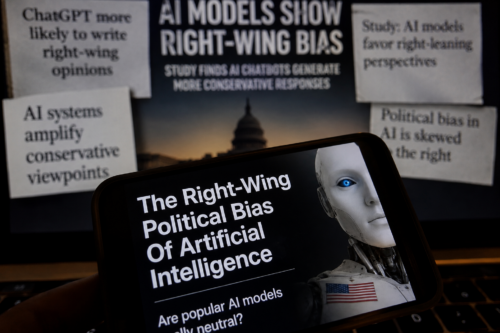
As the new television season begins, the news bulletin show is starting with refreshed content. For this reason, I wanted to experiment with using AI to find international and domestic news quickly. My experience was indescribably and overwhelmingly negative. Receiving information that systematically favors right-wing governments is a powerful example of how Artificial Intelligence (AI) is not a neutral tool, but rather a mirror that reflects the biases of its creators and its data.
My question, “Is AI right-wing?”, touches on the heart of one of the most intense debates in technology today. The answer is complex: AI does not have an inherent political ideology, but the choices made at every stage of its development—from the training data to the people who “fine-tune” it—can cause it to display specific political orientations.
But where does this political bias come from?
Political bias in AI does not arise from a conspiracy theory, although some people will say that it is a conspiracy theory because it diversifies and manipulates the masses; it’s a combination of technical and human factors.
Training Data: Language models are trained on enormous amounts of text from the internet. If this material contains more articles, analyses, or statements from right-wing sources, the model will learn to reproduce that style and those views. However, research suggests the opposite: many large models display a left orientation because data from the internet tends to be more liberal, which personally was not what I experienced. It may be a narrative used to justify the continuous feeding of information from the right.
Human Intervention (RLHF): A crucial technique is “Reinforcement Learning with Human Feedback.” Here, people rate AI responses to teach it what is considered “useful” or “safe.” The political beliefs of these evaluators can influence the outcome.
Owners and Interests: As I correctly point out, the companies that create AI (OpenAI, Google, Meta, etc.) have owners and investors with their own interests. Their decisions about what should be included in the data or how the model should be regulated may be influenced by their business or political environment, which may lead to the right.
The fact that my own research produced material supportive of right-wing governments may be due to several reasons. For example, if the AI has been trained or “tuned in” using data from right-wing news sources that are more open to AI scrapers, then it will reproduce that perspective. Of course, not all AI systems are the same. Research has shown that models such as Meta’s LLaMA tend to be more “right-wing” compared with OpenAI’s ChatGPT, which is considered more “left-wing.” I did not find this to be the case because I used several different models, and none of them displayed a more liberal or left perspective.
And here I come to wonder: is AI “artificial” or real?
AI reveals “how artificial it really is” when it crosses a certain line. AI does not “think” about or “understand” politics. It recognizes patterns in data and reproduces them. If the data is biased, the output will be biased. This does not make it any less “artificial,” but it reveals that artificial intelligence is, in reality, a reflection of human intelligence—with all its imperfections and biases.
AI is not inherently right-oriented, but it tends to move in a right-oriented direction. It is a tool shaped by the choices of the people who build it and by the data with which it is fed. My experience highlights the need for critical thinking: when we use AI, we should always ask ourselves, “Who created this tool?”, “What data was it trained on?” and “What interests might it serve?” Transparency in the training process and diversity in the data are crucial to creating more balanced and reliable AI systems.
If you use AI, try afterward to research and verify your sources the old-school way, as we did before its advent.