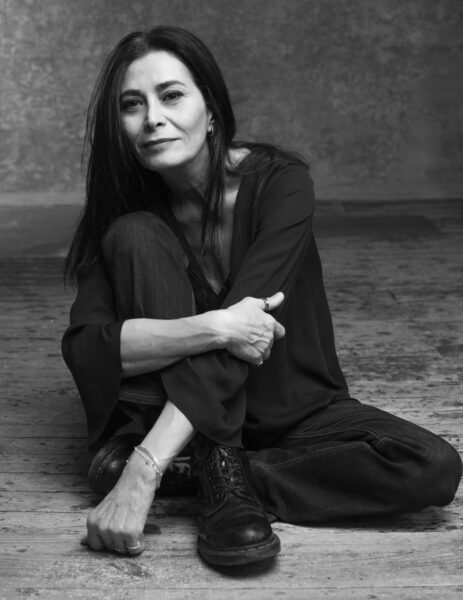
Darina Al Joundi is a Lebanese-born actress and writer whose work spans theatre, film and television in Arabic, French and English. She began performing as a child in Beirut and later emigrated to France, where she built a stage career and co-wrote the acclaimed one-woman show Le jour où Nina Simone a cessé de chanter, which explores exile, trauma and citizenship. Her performance at the 2012 Avignon Festival drew high-profile attention and helped accelerate her naturalization as a French citizen. Al Joundi has appeared in international films and series—including Our River…Our Sky and The Man Who Sold His Skin—and frequently speaks on women’s rights and refugee experiences. Her work is noted for mixing personal testimony with political themes.
Can you share some moments of your childhood and how your family and environment influenced you to develop a more global view?
I had a father who was a writer, journalist and a philosophy and Arabic language teacher and a mother who was one of the first radio speakers in the Middle East. Thanks to my father and his friends and the life he used to have, we were always surrounded by poets, writers and journalists. There were always parties at the house. Also, wine was always floating in the music. So, I had a childhood full of knowledge, books, happiness, friends, and very interesting discussions for a child like me. My father used to give me books to read from a very young age. He offered me the chance to watch movies and to listen to music. He had a lot of influence on my evolution in the arts, culture and knowledge.
Of course, I started acting at the age of eight on Lebanese TV. So, since my childhood, I was a working child as an actress and that very much influenced my childhood. I didn’t have a childhood that resembled others. I had to go to the shooting twice a week while going to school and then there was this atmosphere at home that made our lives full of joy, culture, music and happiness.
What motivated you to transition from Lebanon to France and pursue a career in acting there?
I’ve always been an actress in my life. And the things that I was doing in the Arabic world weren’t sufficient for me. On an artistic level, on a very high-quality level of work. And I wanted more; I wanted something else. I started wanting to leave and work in Europe at a very young age. I left Lebanon for Europe at the end of the 90s. Then went back when my father died in 2001. This is where I had my traumatic experience with the rest of my family, my mother and my sisters. And the minute I had the chance to leave, I left. And I started my new career here. I came for more freedom, more freedom to express myself, more freedom to live daily. I was looking for more professional, personal and intellectual freedom in my life.
How did your one-woman show Le jour où Nina Simone a cessé de chanter reflect your personal struggle to obtain French citizenship?
Well, it wasn’t “Le jour où Nina Simone a cessé de chanter”, which means the day Nina Simone stopped singing, that gave me the French nationality. It was my second play that’s called “Ma Marseillaise,” in English “Marseillaise my way”. This is the play that gave me the nationality. This is a play that talks about my struggle to obtain my papers and my French nationality. One week before the opening of the play, I had the refusal of my papers in France. So, I added this information to my play by the end of the play. And a critic from Le Monde newspaper, the biggest theatre critic in France, came and watched the play. And she wrote an article about the play, saying, “Mariane doesn’t recognize her sisters anymore. Mariane is the symbol of the French Republic”. The same day, the French Interior Minister, who was Emmanuel Valls, called me at the theatre and told me that the problem I had was a very administrative problem. They had to change the law. And he announced to me that he would change the law so I could have the French nationality and represent the Republic in the world as an artist.
As someone who has spoken at the French Ministry of Women’s Rights, how do you see the intersection of art and activism in promoting gender equality?
Well, I think about how to do it in our work. Each one has to talk about their own convictions. It touches more the author side of my work because, as an actress, I do not always have the choice. Even though I do get a lot of proposals for acting, sometimes they are a bit similar to my way of living and activism. But it’s more on the author’s side because this is where I can express my opinions. But I think it’s only about being sincere and that each one of us talks and expresses their opinions, their experiences. And this is the only way that we can move forward.
You are known for your stage performances, but you also have a notable filmography. Do you prefer theater or cinema and why?
I’m known as a stage performer in Europe and I’m also known abroad. Even though I started when I was eight on TV, I don’t have a preference, actually. Each one of radio, cinema, TV and theater, each one of these ways of expression has its own challenge. Actually, what’s luxurious is time and the place where we have more time than any other kind of work. The theater is the place where we have more time, so we have the time to build the character and then to perform. The day of the premiere is the day when we really start working and it continues working until we stop performing the play. It can be for years and each time you make it better. Things get better, silence gets better. The film is a challenge; it’s very difficult because sometimes we start with the first scene and the next day we do the last scene and three weeks later we go back to the first scene to continue it from another decor set. So all these have to be in an intimate situation, but you are surrounded by hundreds of people. You cannot control anything in the cinema or on TV. Plus, on film, the good thing is that we have a bit more time than on TV. The luxury is time. So, theater can give you this luxury that TV and film don’t give you and it makes it harder to continue being on the same level as the character all the time. So, each part of this way of expression is either theater, film, TV or radio. Radio is another level of expression, another level of work. Each one of them has its own challenges, its own difficulties and its own magic. The magic and the passion are everywhere for me. I love all. I cannot do one and not do the others. I have to jump from one to another, like do TV and then do a film and then do a play, which I do all the time and that makes me really happy and more passionate about my work.
The preference between film, TV and theatre, there’s one thing I would like to add: theatre permits us to condense all the work that we do in months to be able to do it in minutes for the movies or for TV, which means, as actors, we learn the most important thing is to be present in the moment. And theatre is an excellent professor for it and the technique that we use in theatre permits us to use the same technique, but in a very short time, to be able to do the same for a film or for a TV show.
Among your roles in productions like Homeland, Tyrant and The Romanoffs, which character challenged you the most as an actress?
Well, among all these projects, there’s also the New Look; there’s Athena, a film on Netflix by Romain Gavras. There are a lot of films or shows that I did that are really challenging for me. Actually, the last project I did for French TV, which was called “Kabul”, was a big challenge because I had to learn a language that I didn’t know, Dari, one of the Afghan dialects. And we didn’t have a lot of time. It’s a project like in the US; they would do it in six months. We did it in three. A big production for France, but not really for the US as a TV production. But it was very challenging and also the most beautiful experience of shooting in my life. It was a very beautiful experience, an adventure with the crew, with the screenplay, with the directors, and with the other actors. This was a very challenging but very beautiful experience. “Kabul” was for France2FrenchTV.
Your father, Assem Al Joundi, was a prominent author and politician. How did his legacy shape your own path in the arts?
My father was a poet, journalist, writer and militant activist for freedom. He shaped my life not only during my childhood, but also during my adolescence and all parts of my life. His way of thinking, his way of doing things, he was one of a kind; he used to say what he thought and do what he said. He was a real free person and he did it with his own daughters, not just talking about it. I remember our house was always full of his friends, writers, politicians, poets and journalists. There was always music, words and books in my childhood and my youth. And just the way that we used to debate, to discuss, to talk, to drink together, to have fun together. Yes, he showed me how to love life.
And he showed me that to be free, you have to be mainly independent financially and that we have to be responsible towards our freedom and to assume all our actions and their consequences. Then you have the right to be free.
When preparing for roles, especially in emotionally intense works, what is your approach to embodying complex characters?
My approach to the roles that I do is actually very simple and very difficult. It’s just being there in the moment, not before, not after and just live the instance, the second that you are living in. That’s the most difficult and the easiest thing at the same time. It’s a process that you put in your body and your head and your soul. But for me, it’s this: it’s being able to be present in the moment. This is it.
How do you navigate your dual identity as a Lebanese-born actress who is now a French citizen in your work?
There’s no duality for me and there’s no me born a Lebanese actress and being a French citizen. It’s always me. It’s me, the same person. The way I live now resembles my way of being more than the way I used to live before; I’m still the same person. I just have more space, more freedom to express myself, to work, and more chances.
Are there any upcoming projects or collaborations that excite you, either in theater or cinema?
Well, the most exciting upcoming project for me is that I’m trying to adapt my second novel, which is called “Prisoner of the Levant”. It’s about the life of May Ziadeh and I’m hoping that by the end of next year, I will be in preparation for shooting my first long feature film and that’s the most exciting project I’ve been working on for five years now, so I hope I’ll be able to do it.