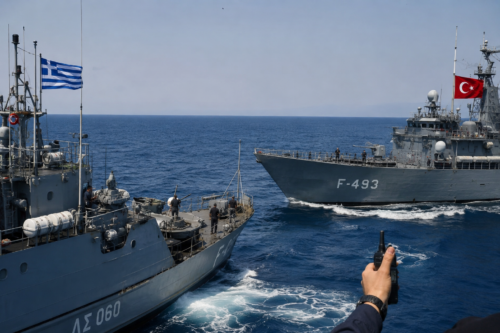
In today’s world, the Turkish leadership persistently promotes the idea of the “Blue Homeland,” a nationalist doctrine, sometimes becoming a narrative, that claims maritime zones, islands, islets and strategically important energy deposits in the Aegean and the Eastern Mediterranean Sea. Erdoğan’s rhetoric has become a fuse: from diplomatic claims to military exercises and unilateral NAVTEX notices. It is well known that expansionist policy does not stop at maps; it is a political tool to cover domestic economic instability and to manipulate society. But what does this mean for peace in the region and how close are we to open conflict?
The threat of war is not purely theoretical. Small incidents, dogfights, harassment of vessels and aggressive NAVTEX notices can escalate quickly due to miscalculation or technical failure. Turkey has capable armed forces and a president who does not hesitate to use tension as an instrument. If the Greek side responds impulsively or remains inactive for too long, the risk of military confrontation increases. It is therefore wrong to assume the situation will “deflate” on its own.
What should Greece watch for and do? Be diplomatically prepared: strengthen alliances with the EU, the US, Cyprus and Eastern Mediterranean countries. International legal and political isolation of Turkey is a tool. Deterrence with composure: a consistent, proportional and measured military presence at critical points, not ostentatious displays of force that provoke escalation. Also, naval and air superiority: modern equipment, exercises with allies, infrastructure improvements and formation of a rapid reaction force to avoid the self-destructive “instant response.” Legal alliance: bring disputes to international fora (the International Court, UN forums) when advantageous and use international law to set limits. Another element is internal resilience: strengthen the economy, pursue an independent energy policy and social cohesion so citizens do not become “victims” of panic-driven foreign policy. And most important is information and calm: public discourse should avoid hysteria and demagoguery. Information should awaken without terrorizing.
Greece can afford neither naivety nor excessive provocation. The “Blue Homeland” can also be an opportunity: to demand that the international community impose rules, rely on the power of law and prepare with a plan. If the Greek response is wise, calm and well-coordinated, the region can overcome the challenges without bullets. If it is reckless or divided, the road to catastrophe is short and then our own politicians will be to blame, not only those across the border.
The “incompetent” politicians of Greece, a label often applied to the Greek elite because they were obsessed with personal rather than national goals and benefits, constitute the greatest obstacle. The use of populist rhetoric rather than substantive reform implementation creates an atmosphere of awkwardness that discourages diplomacy. When the incompetent govern, the capable who do not resist enough become guilty, leading to a general devaluation of the political system.
Greece’s geopolitical survival depends on its ability to link its external importance to internal stability. Without that connection, even the most strategic territory will become merely a field of contention for other powers.